Showing posts with label Pond-blog. Show all posts

Wednesday, November 30, 2011

Interactions in the Nose Hill pond, by Sarah

     Interactions between organisms occur every time organisms have some sort of come into contact with each other. These interactions can be harmful, beneficial, or inconsequential for one, both, or all of the organisms. Here we will be examining six types of interactions between the organisms present in the nose hill pond.
     Figure 1.  This picture is of the pond, which is located at the southwest corner of Nose Hill. The picture was taken by me on Sept. 22, 2011.
     There are many types of interactions that take place between organisms on the hill. The interactions that will be examined in this blog are: predation, parasitism, mutualism, commensualism, intraspecific competition, and interspecific competition.
First, some definitions:
Predation (the predator/prey relationship): when a predator kills another organism (its prey)   
   for eating.
        Predator: any organism that kills other organisms for food (Freeman, 2008)
        Prey: an organism that is killed and eaten by another organism.
Parasitism: a symbiotic term relationship between two organisms that is beneficial to the                 
   parasite but detrimental to the host (Freeman, 2008)
        Parasite: an organism that lives on or in a host species and that damages its host.
        Host: an individual or species on or in which a parasite lives. (Freeman, 2008).
Mutualism: a symbiotic relationship between two organisms that benefits both (Freeman,       
   2008).
Commensualism: a symbiotic relationship between two organisms where one organism
        benefits and the other organism is not significantly affected.
Intraspecific competition: when two or more organisms of the same species vie for the same
        limited resource.
Interspecific competition: when two or more organisms of different species vie for the same
        limited resource.

Here is a list of the organisms that were identified on Nose Hill
-stagnant pond snail Lymnaea stagnalis
-flatworm Procotyla fluviatilis
-damselfly larvae Agriocnemis femina femina         
-water boatmen Corixidae notorectidae 
-dytisscidae hydaticus (species of predatory water beetle: common name unknown)
-promenetuss umbilicatellus (small species of snail: common name unknown)
-freshwater leech macrobdella decora
-mallard duck anas platyrhynchos
-cattail typha latifolia
-larger duckweed spirodela polyrhiza
-hornwort ceratophyllum demersum
-mares-tail hippuris vulgaris
-Pondweed potamogeton amplifolius
-deer (identified by tracks left in mud)

Other species of birds, smaller than the mallards, were observed flying around the pond and hiding in the cattails; however, these birds were moving too quickly or were too far away for identification. Evidence of nests, in the form of small, condensed pieces of material, were also found.
       Each of these organisms interacts constantly with all of the other organisms. In the interest of     keeping this blog relatively short, the examination presented on these species will focus on the organisms highlighted in the list.
Interactions
Predation
     Predation is when one organism eats another. Here are two examples from Nose Hill:
-          Pondweed is eaten by mallard ducks. Therefore, the duck is the predator and the pondweed is the prey. The ducks are further classified as herbivores, because they are eating plants rather than other consumers.
-          Flatworms eat smaller organisms, such as amoebas and water fleas. In this example, the flatworm is the predator and the smaller organisms are the prey. These flatworms are predatory, because they eat other consumers instead of eating producers/plants.

Parasitism
Parasitism is when an organism (the parasite) feeds on another organism (the host) without killing the host.
-          An example of parasitism in the Nose Hill pond environment is the freshwater leech. The leech attaches itself onto another mammal, such as a deer or mallard. In this example, the leech is the parasite and the other animal is the host.

Commensualism
       Commensualism is when one organism benefits from the relationship while the other organism is neither benefitted nor harmed. Here is an example of commensualism in the pond:
-          Deer, birds, leeches, flatworms, and pond snails all use cattails as shelter from predators and weather conditions. The animals benefit by gaining shelter, while the cattails experience no significant benefit or harm.

Mutualism
      A mutualism relationship is an interaction in which both organisms gain. Some examples from Nose Hill are:
-When birds take the fluffy seeds produced by cattails and use them to build tests. The bird gets a nice, comfortable nest in which to raise its offspring, and the cattails seeds are spread by the bird. Therefore, both organisms are benefitted.
-Pond snails, which are scavengers, consume and decompose dead cattails and other wastes in the water. The pond gets food to survive and reproduce, while the cattail benefits from the nutrients released by the snail during decomposition.

Intraspecific competition
     Intraspecific competition is competition between two members of the same species. For example:
-          Cattails grow in groups on the side of the nose hill pond. These cattails compete for space and the nutrients in the soil and water. They compete both for space for themselves and space for their seeds.

-          Leeches compete for hosts. The only hosts available for these leeches are a few ducks and the occasional deer or other mammal that come to feed and drink. This means that the leeches compete to gain a suitable host.


Interspecific competition

     Interspecific competition is competition between members of different species.

-          The different plants in the nose hill pond compete for space to grow and nutrients in the soil and water.
-          Birds compete for the fluff that is released every year by the cattails, for use in building their nests.
The examples of interactions given here are only a few of the wide variety of interactions constantly ongoing in the nose hill pond. However, they should serve to give a good idea of the different interactions that are occurring in the pond.

References
Freeman (2008) Biology. San Francisco: Pearson Benjamin Cummings
Royer, F.; Dickinson, R. (2007) Plants of Alberta. Edmonton: Lone Pine publishing.
Lahring, H. (2003) Water and wetland plants of the prairie provinces. University of Regina:   
     Canadian Plains Research centre.
Clifford, H. (1991) Aquatic invertebrates of Alberta. Manitoba: DW Frieson & sons.


Tuesday, November 29, 2011

Interactions and Succession in Nose Hill Park’s Pond, by Katherine and Alice

On September 22, 2011, Sir Winston Churchill High School’s Biology 20 IB students went to Nose Hill Park in Calgary, Alberta, Canada to investigate the three major ecosystems present there – the pond, forest, and grassland. This blog post will be focusing on the pond (please view Figure 1. for a sketch of the pond and general information), and the symbiotic interactions of its organisms. It is important to note that no comparisons could be made between Edworthy Park and Nose Hill Park, as the park does not possess a still-standing body of water such as a pond with a comparable ecosystem. Now before we begin delving into the core of this post, let us first establish some context. Ecology is the study of organisms in relation to their environment – not merely the physical components of the environment but their effect on other organisms whose lives overlap theirs, particularly those on which they feed and for which they in turn provide sustenance. Symbiotic relationships (or symbiosis) describe the interactions between two organisms of different species, where these interactions tend to take place for most of the organisms' lives. There are a number of different types of interactions, each deserving an innumerable amount of research, however the ones we are going to explore include mutualism, parasitism, commensalism, predation, interspecific competition, intraspecific competition, Batesian mimicry, and Mullerian mimcry. In addition, we will discuss primary and secondary succession in relation to Nose Hill Park.
Let’s begin with predation, a form of symbiotic relationship where one species acts as a predator that captures and feeds on the other organism that serves as the prey. Predators may or may not kill their prey prior to feeding on them, but the act of predation always results in the death of its prey and the eventual absorption of the prey's tissues through consumption. (Freeman, 2008) The main predators found at the pond are the Pond Wolf Spider (Pardosa pseudoannulata), Harvestmen (Opiliones), damselfly and dragonfly nymphs and adults such as the Aeshnidae, Water Boatman (Corixidae), Predacious Diving Beetle (Hydaticus modestus), Flatworm (Dugesia polychroa), Wasp, Mallard duck, and Black-billed magpie. To further understand the trophic levels each predator is in, please view Figure 2 for a food web and the video below for pictures. Pond Wolf Spiders commonly capture prey such as damselflies and dragonflies, injecting them with fatal poison using its chelicerae, and then proceeding to consume them. (Clifford, 1991) In addition, damselfly and dragonfly nymphs will use their powerful jaws to kill and eat mollusks, other insects, crustaceans, worms, and small fish. One more example is the Hydatiscus Modestus (Predacious Diving Beetle) which will cling to grasses or pieces of wood along the bottom of the pond, hold perfectly still until prey passes by, then lunge, trapping their soon-to-be-food between their front legs and killing them by biting down with its pincers. Their usual prey includes tadpoles and glassworms, among dozens of other smaller water-dwelling creatures. (Clifford, 1991) These are all cases of true predation, where the prey lose their lives while the predators gain chemical energy from consuming the prey. Mathematical models of predation are amongst the oldest in ecology. The Italian mathematician Volterra developed his ideas about predation from observing Adriatic fishing fleets. When the number of fishermen increased due to a particularly successful fishing season, after a time, the fish population declined due to over-harvest, and thus the number of fishermen also declined. After some time, the cycle repeated. (Williams, Nichols & Conroy, 2002) Logic and mathematical theory suggest that when prey are abundant their predators also increase in numbers, reducing the prey population, which in turn causes the predator population to decline. The prey population sooner or later recovers because once the predator population declines, the prey can fuel a new round of population increase, consequently beginning a new cycle. Prey evolve behaviors, structural armor, and other defenses that reduce their vulnerability to predators every cycle. Predation, while not the only complex community interaction, has often had strong and long-lasting (although indirect) effects.
            Next let’s focus on mutualism – a relationship between two or more species where both receive mutual benefit from the interaction. The most common form of mutualism is when one resource that is needed by one participant is traded for a different resource needed by the other. The first example vibrantly present in the Nose Hill Park pond is the mutualistic association between a fungus and algae. The fungus provides a tough, waterproof body able to withstand extreme environments on rocks, being good at obtaining water and secreting acids to dissolve minerals from the rocks.  It also produces carbon dioxide.  All of these materials are then provided for the algae, which use them in photosynthesis to produce sugars, which are then shared with the fungus. Another example is between algae and freshwater snails, where the algae find substrates on the shells or carapaces of the snails, which in turn benefit from the camouflage. Camouflage is a method of crypsis (hiding), which allows an otherwise visible organism, or object to remain unnoticed, by blending with its environment. (Freeman, 2008) All of these examples found in Nose Hill Park have both participants gaining from their relationship with each other.
            Our next prevalent interaction under study is parasitism. Parasitism is a form of symbiosis in which one organism, the parasite, grows, feeds, and gains at the expense of another organism usually of a different species, the host, which harbors the other organism. The interaction may cause injury to the host thus, when there are more parasites, it means that there will be less hosts due to the nutrients the parasites are taking away. There are many cases of parasitism occurring in the pond, one of them being when a wasp stings and paralyzes a Pond Wolf Spider, afterwards taking it to a nest and laying an egg in it.  The larvae will consume the still-living spider; often from the inside out. This is a parasitic relationship as the host, the spider, loses by undergoing fatal harm while the parasite, the wasp larvae, gains as it cannot survive without the nutrients and shelter the spider’s body provides.
            Another vital symbiotic interaction is commensalism, a relationship between two organisms usually of different species, where one benefits from the other, the host, which remains unaffected. The organism that attaches itself onto the host will receive some type of profit such as food or shelter while the host doesn’t undergo a change at all (neither positive nor negative). One example found at the pond is between marsh wrens and cattail plants. The marsh wrens build their nests on the stalks of cattails, gaining shelter from predators, but do not affect the plant itself. This is an instance of commensalism because the organisms that are using primary producers as protection gain because they stay safe and the primary producers do not gain or lose anything. Another example of commensalism found is between damselfly and dragonfly nymphs and pondweeds. The nymphs hide at the bottom of the pond among the pondweeds, allowing them safety and camouflage from predators as well as the ability to surprise and attack prey. In turn, the nymphs affect the pondweeds neither positively nor negatively.
            Next let’s focus on intraspecific competition, which is conflict between individuals of the same species over a resource that is in short supply. One example of intraspecific competition is between leeches, fighting over food sources. Due to chemicals that humans use (like fertilizers) draining into the pond, plants will be able to grow but animals that may use the pond as drinking water will suffer from the toxicity. The fertilizers in the pond can also lead to algae blooms in the water, which will use up the dissolved oxygen, leaving less oxygen for other aquatic species. In addition, many vehicles drive by Nose Hill Park polluting the air, while visiting humans litter, introducing new or harmful substances to the pond ecosystem, which can affect the animals because they have not adapted to the new chemicals. Due to these factors, organisms in the pond such as snails, frogs, dragonfly and damselfly nymphs are easily put at risk. This is an example of intraspecific competition because leeches of the same species feed on these organisms in short supply, consequently resulting in conflict. Some leeches occasionally even eat other leeches as both a defense mechanism and as a way to gain sustenance. Both leeches lose from expend energy and both are usually harmed in the conflict, hence this is a solid example of intraspecific competition.
            Very similar to intraspecific competition is interspecific competition. This is the conflict between two or more different species for the same limited resources such as food, nutrients, spaces, or mates. The individuals of one species will likely experience a reduction in population or growth as a consequence of resource exploitation or interference by individuals of the other species. One example of interspecific competition is between dragonflies and damselflies for prey. Because of pollution in both the water and air, many organisms the two species prey on do not grow as large or live as long, thus being in short supply. Consequently, dragonflies and damselflies will compete for the prey, causing one species to eventually undergo a reduction in population either due to starvation or interference competition (direct physical confrontation). This is a solid example of interspecific competition as the species in competition are different and the resources in question are of limited supply. In addition, consequent conflict usually arises and the stronger species usually bests the other, weaker one, and gains the resource, however both lose energy in the process.
            Now let’s focus on Batesian mimicry. Batesian mimicry is where a harmless species, the mimic, has evolved to imitate the warning signals of a harmful species, the model, to a common predator. This form of mimicry can employ the deception of any of the senses and must depend on a disparity between unpalatable and edible species. The mimics must be smaller in population, while the models must be very abundant, with a high probability that the predator will try to eat the inedible model species first. In this type of mimicry, the mimic benefits as it gains protection without having to spend energy arming themselves, while the model loses because if there are a large number of mimics, the predator may begin to regard the model as harmless. This can also be detrimental towards the predator as it may begin to more frequently encounter toxic prey while initially thinking it was harmless. An example of Batesian mimicry present at the Nose Hill pond is when harmless hoverflies mimic bees’ and wasps’ distinctive bright striped coloring. As members of Diptera, all hoverflies have a single functional pair of wings, similar to a wasps’. (Clifford, 1991) They are also brightly colored, with spots, stripes, and bands of yellow or brown on their bodies. Due to this coloring, they are often mistaken for wasps or bees; thus exhibiting Batesian mimicry. This is also a form of protective coloration where the coloration or color pattern of an animal affords it protection from observation by its predators.
Finally, a look at Mullerian mimicry – where two or more harmful species that don’t have to be closely related and share one or more common predator, mimic each other’s warning signals. If a common predator confused two species with one another, individuals in both would be more likely to survive. In this form of mimicry, both parties serve as co-mimics or co-models, however if one species were to be more rare than the other, the more common species would be the model and the other the mimic. What is interesting about Mullerian mimicry is that the predator in question also is at an advantage because although it is not gaining sustenance, it is being deceived into evading potentially harmful encounters. An example of Mullerian mimicry present in the Nose Hill pond would be where flatworms, which excrete toxic body fluids when dying, mimic the poison-carrying nudibranchs. (Clifford, 1991) This turns potential predators such as fish, away from them, through visual recognition. In this form of mimicry, all parties benefit  - as predators learn to avoid the group as a whole.
Let’s move on to succession – the vital process that developed Nose Hill Park into what it is today. Hundreds of thousands of years ago, the land of which Nose Hill Park occupies today was covered by a large river. The large river was then transformed in to a sizeable glacier during the last ice age, its glacial movements shaping the distinct hills and valleys present today. After the ice age ended, a form of succession – primary succession – took place and began the long process of establishing life. Ecology succession is the process of change in the species structure of an ecological area while succession is the process of change in the environment over time. More specifically, there are two major types of succession, primary and secondary. Primary succession is the gradual colonization of a habitat of bare rock or gravel, usually after an environmental disturbance that removed all soil and previous organisms. (Freeman, 2008) In this case, Nose Hill Park had just been covered with glaciers for a couple thousands of years thus the succession over these areas would consequently require extra time and forces to prepare the land for further development.
            A pioneer community is a collection of species that colonize previously untouched land, usually leading to ecological succession. These species are the first organisms to begin the chain of events leading to a flourishing biosphere or ecosystem. (Freeman, 2008) Pioneer species that likely cropped up in Nose Hill Park include lichen, small ephemeral bunchgrasses and wildflowers. Winds likely carried seeds from other plants over and as a result, grasses would have begun to grow on sand dunes or dry areas, while lichens would have tended to grow in damp and rocky environments. In the pond, the pioneer community probably consisted of hardy, long rooted plants such as green algae, Pickleweed, and mosses. Pioneer species die creating plant litter, breaking down to make new soil for secondary succession or nutrients for small organisms in aquatic environments.
            However, the pond located in Nose Hill Park did not form from natural succession or natural forces. Although the pond was a man-made storage for storm run-off from surrounding communities, secondary succession still occurred within the pond itself – a gradual colonization of a habitat after a disturbance that removed some or all previous organisms but left the soil intact. Since soil is provided, secondary succession proceeds at a faster past. (Freeman, 2008). Before the pond became storage for storm run-off, the area was simply a depression in the land covered by grass, shrubs, and organisms adapted to that environment. After the reroute of water and over time, sturdier organisms adapted to the slightly toxic pond water began to appear, evolve and multiply. Since the environmental conditions were continually changing, new species were introduced and the initial ones evolved to adapt to the ever-changing ecosystem, cycling again and again.
            A climax community is the secure and final ecosystem that develops from ecological succession. (Freeman, 2008) A prediction of Nose Hill pond’s climax community is that the pond will have all the present organisms it has now, except with more fish species adapted to low oxygen levels. This prediction was made on the basis that despite all the pollution from car exhaust, litter, and street runoff, the pond is still teeming with life. The only organisms in rare existence are fish, which are extremely sensitive to pollution. Thus, the pond with evolved fish would be the climax community – the sere having reached equilibrium and adapted to the climax conditions of the environment. A sere is a transitional stage found in ecological succession in an ecosystem advancing towards its climax community. A seral community is the name given to each group of plants within the succession, an example being a polluted pond. During the first two years, algae, fungus, and moss would be abundant. After a few more years cattails and small organisms would start to appear; and about six to eight years after the clearing, the area would likely to be teeming with aquatic animals. Each of these stages can be referred to as a seral community.
            We have now explored both succession and the multitude of interactions prevalent in Nose Hill Park’s pond, discovering along the way the complexities of its organisms and its evolution from the past to present. There is so much still to be found, and we hope this inspires everyone to take a trip down to Nose Hill Park and enjoy the environment as much as we did.

Figure 1. Sketch of Nose Hill pond. (for larger version click http://www.flickr.com/photos/69278508@N02/6300199091/in/photostream/)
Figure 2. Food web of Nose Hill pond (for larger version click
For the bibliography, please click http://www.scribd.com/doc/71094495/Nose-Hill-Refs


Monday, November 28, 2011

A day at the Pond, by Jeff and Liz

On September 22, 2011, the students of Sir Winston Churchill High School’s Bio 20 IB went on an expedition to Nose Hill Park in Calgary, Southern Alberta to observe and record data about the exciting ecosystems. Nose Hill Park is a man-preserved environmental area located in the North West quadrant, situated between John Laurie Blvd and Shaganappi Trail of Calgary, Alberta and spans 1127 hectares making it the largest government owned park in Calgary.
Calgary is situated between two different ecological biomes; a region of the earth that we identify as having certain patterns with temperature, precipitation, and living organisms. The biomes that Calgary can be considered both in are the Grassland biome and the Boreal Forest. Nose Hill Park is a well preserved natural area that is controlled by the municipal government and is open to the general public.
As we first entered the park, we noticed the no dogs sign. We were told that because of the abundance of ducks and other organisms, dogs were banned in order for the ducks to remain in their environment undisturbed and safe. We learnt that Nose Hill pond is a drainage pond, used to collect and store rainwater from surrounding neighbourhoods such as Edgemont and Ranchlands. The pond also provides the only major water resource for surrounding organisms in Nose Hill, as the other sources come and go according to fluctuating rain levels.
  For this entry, we will be exploring aspects of the pond such as the significance of the organisms, how they interact, and the pond environment that these little creatures live in. The main focus of our entry is to discuss the effect of a realistic natural disaster on the species that we have captured and identified.
We observed specifically the storm drainage pond, pictured in figure 1.

Figure 1.  A picture of Nose Hill Pond taken on September 22, 2011 by Elizabeth in SWC’s Bio 20 IB class using a Canon PowerShot SD850 IS.

With one simple swoop of a butterfly net, we were able to capture several insects including the damselfly and a daddy long-leg spider, which is mentioned later in Table 1. The surrounding vegetation around the pond provided a perfect habitat for the damselfly to flourish, as we also observed a couple of damselfly attempting to reproduce. Unfortunately, my partner interrupted them during the copulation as he tried to catch them. We also caught a couple of aquatic organisms such as leeches. They are quite unique as they, like their name suggests, “leech” blood from other organisms to survive. This is an example of parasitism, a type of symbiotic relationship, or in simpler terms, interaction between organisms. Parasitism is an interaction between two organisms in which one organism benefits while the other is negatively affected, physically in the case of the leeches. This is just a small sample of the kind of interactions Nose Hill pond houses. Other samples of interactions between organisms include mutualism, commensalism and Intraspecific competition. For starters, intraspecific competition is competition between two organisms within the same species for a limited resource; a perfect example of intraspecific competition in Nose Hill pond is the competition between mating in damselflies. When we caught our damselflies, we noticed that two of them (presumably the males) were fighting for the lone female in the plastic bag, much like other species in the wild. We will be talking about the importance of symbiotic relationships later in this blog, as well as the consequences when these relationships are threatened by natural disasters.

            In our adventure, we identified the following species as shown in table 1.

Species (common name)
Scientific Name
Physical Descriptions
Daddy Long Legs Spider
Pholcus Phalangioides
Roughly 1cm body length (not including legs), legs 5 or 6 times the length of the body.
Brownish grey in colour with darker brown markings on the body.
Water Boatman
Corixa Punctata
Aquatic insects that paddle along the surface of water. Although aquatic, they lack gills. Normally grow between 5 – 15 mm long. Are able to stay buoyant due to the tiny hairs on their legs.
Damselflies
Ischnura heterosticta
Roughly 4 cm in body length. Bright blue in colour. Structurally similar to dragonflies but slimmer, generally smaller and their wings fold over backs.
Scud
Roughly 0.7cm in body length,

Table 1. Some of the species identified from the Nose Hill storm-drainage pond in Calgary, Alberta by Jeff Ma and Elizabeth Tang, students of the 2011 Biology 20 IB class at Sir Winston Churchill High School.

The significance of our topic is due to the idea of succession; the gradual and orderly process in which an ecosystem undergoes progressive replacement of organisms. We will evaluate how an organism will recover after a natural disaster where the habitat is heavily damaged and is in need of serious repair. In order to evaluate the effect of a natural disaster on the species, we have to become aware that interactions that occur between these four organisms as well as other interactions that occur in general areas such as the pond.
In  Calgary, the major realistic natural disasters that can occur based on historic trends are hailstorms, tornados, flash floods, and fires.
If any of the mentioned natural disasters happened to hit our Nose Hill drainage pond, the most evident effect these natural phenomenon would be physical destruction of flora leading to an unsettling of the trophic levels because of the lack of producers that feed the primary consumers. Trophic levels are the ranking of living things by their order of consumption. Producers include plant life that use solar energy to fabricate energy for themselves. Primary consumers are the organisms that consume producers, followed by secondary consumers and tertiary consumers as shown in the following diagram.


Figure 3. The Trophic Levels of organisms. Arrows signify consumption of one organism by another, through the different trophic levels.

Damage specific to a fire would be heavy destruction of all plant life compared to other disasters such as tornadoes, flash floods, and hailstorms. Damage specific to both a flash flood and hailstorms would be over fertilization and imbalance of nutrients due to erosion and presence of debris from property damage and drowning. Over fertilization includes high levels of phosphate, nitrogen and potassium which will lead to an algae bloom. This coverage of aquatic plants not only blocks sunlight for the underwater organisms, but it reduces the oxygen levels as well.
Many organisms depend heavily on these relationships, hence the term, symbiosis which means living together. Therefore, if something like a natural disaster were to happen, wiping out a good percentage of a certain species due to loss of habitat or food, other organisms that depended on that one species will suffer as well. To put it simply, all organisms made and will make connections that, if broken, cause ripples throughout this web of life. Natural disasters initially cause habitat destruction; this reinforces the idea and importance of succession, where the ecosystem gradually undergoes a change in which organisms will adapt physically or behaviourally.
Why is succession so important? It is simply because if every natural disaster that occurred wiped out the entire population of every organism it encompassed, soon enough, every species would become extinct.
All in all, the pond that we visited in Nose Hill is an essential habitat to many organisms and houses several symbiotic relationships. It also provides a significant resource of water for many surrounding organisms. We conclude this entry based on the realization of how truly vital this pond is, not only to the many organisms immediately surrounding the area, but of those all connected through the different trophic levels and the Calgary area as a whole. These interactions mentioned in the blog will not be possible without the location of the pond, the pond itself and the vegetation surrounding it.


The Interactions Found in Nosehill Natural Environment Park by Ashley and Eugenia

            Through our trip to the pond in the south of Nosehill Natural Environment Park on September 29th, 2011, we were able to collect and preserve many different species of visible living organisms.  Through research, and help from Dr. T. Pike, the Biology 20 IB teacher at Sir Winston Churchill High School, in species identification, the interactions between the species were established.  A simple explanation of each species interactions in the environment at the pond is given below, with pictures of the preserved species.

                                         Figure 1. Pond at Nose Hill taken by Ashley and Eugenia on September 29, 2011

Hirudinea (Leeches); Order: Pharyngobdellida, Family: Erpobdellidae
At Nose Hill, a type of leech in the family Erpobdellidae was found in the pond.  Leeches are non-anthropods and are found in freshwater.  Leeches of the order Pharyngobdellida are primarily fluid feeders and are found in standing and running water.  They are predacious, but they do not have jaws.  This allows the leeches to swallow a whole variety of small invertebrates or suck the fluid out of large prey.
These leeches are involved with other organisms through interactions such as predation.  Predation is defined as the killing and eating of an organism which is the prey, by another organism which is the predator.  In one interaction, leeches are the predator and prey on small or large invertebrates.  The leech gains food and energy from the prey which are the invertebrates while the invertebrates are killed.  In another interaction, leeches are the prey and the predators that prey on them are walleyes, which is a type of fish.  The walleye gains food and energy from the prey which is the leech while the leech is killed.  Through these interactions, leeches are shown to have a feeding strategy of a tertiary or higher consumer.    
                                               Figure 2. Specimen of Hirudinea in the family Erpobdellidae found at
                                                         Nose Hill by Ashley and Eugenia on September 29, 2011
                             
                                           Figure 3. Specimen of Hyalella azteca found at Nose Hill
                                                          by Ashley and Eugenia on September 29, 2011

Gastropoda (Snails); Subclass: Pulmonata, Family: Lymnaeidae
            A type of Stagnicola gastropod was found in the pond at Nose Hill.  Gastropods are abundant in most aquatic habitats of Alberta.  The shell of gastropods is always present and it is well developed in freshwater specimens.  Freshwater gastropods are generally herbivorous and they weed on algae growing in ponds, lakes and streams.  Based on their feeding habits, gastropods are a primary consumer. 
             These gastropods are involved with other organisms through interactions such as predation and parasitism.  In one interaction, gastropods are the prey and the predator is a carnivorous insect such as fireflies.  The firefly gains food and energy from the prey which are the gastropods while the gastropods are killed.  Another interaction that gastropods are involved is parasitism.  Parasitism is defined as a long term physical relationship between two organisms where one organism benefits and the other organism is harmed.  Freshwater snails are the hosts for parasites such as the larvae of blood flukes.  The larvae of the blood flukes gain nutrients from living in gastropods such as Lymnaeidae, and the gastropods slowly die because their nutrients have been robbed by the blood flukes.

                                                 Figure 4. Specimen of Gastropoda in the family Lymnaiedae found
                                                      at Nose Hill by Ashley and Eugenia on September 29, 2011

Anisoptera (Dragonflies); Order: Odonata
            At Nose Hill, dragonflies were found around the pond.  The dragonfly is an anthropod.  It is in the class of Insecta under anthropods where less than 5% of insect species have an aquatic stage.  There are over 90 families of aquatic insect in 11 orders present in Alberta.  The dragonfly is under the order Odonata which also has two additional suborders including Zygoptera and Anisozygoptera.  Four families of Anisoptera are found in Alberta which represents approximately 50 species.  The larvae of the four dragonfly families are widely distributed throughout the province.  Dragonflies are predacious in larvae and adult stage.  In larvae stage, aquatic invertebrates are captured with the large labium.  In adult stage, the dragonflies feed on other flying insects.  From this feeding strategy, dragonflies are identified to be tertiary or higher consumers. 
            Dragonflies are involved with other organisms through interactions such as predation.  In this interaction, dragonflies are the predators and prey on insects and aquatic invertebrates.  The dragonfly gains food and energy from the preys which are the aquatic invertebrate and insect while the aquatic invertebrate and insect are killed.  
                                                       Figure 5. Specimen of Anisoptera found at Nose Hill by
                                                                Ashley and Eugenia on September 29, 2011
Vegetation
Around the pond at Nose Hill, numerous species of vegetation were found.  The plants are the primary producers which the primary consumers consume.  

Caddis Fly; Order: Trichoptera, Suborder: Amphiesmenoptera, Class: Insecta
            At Nose Hill, a caddis fly casing was found in the pond, motioning to the presence of Trichoptera larvae.  Caddis fly larvae are adapted to many types of aquatic environments, and live in casings made from rocks, sand, gravel, twigs, leaves, and other debris.  Trichoptera larvae uses substance secreted from silk glands in the lower lip to glue materials together.  With these glands, Trichoptera larvae are able to use the glue like substance to spin and create nets, straining material from the water for food.  Caddis fly larvae feed differently from the adults.  Adult Trichoptera feed only on liquid food, such as nectar or sap, in result of a vestigial mouth.  Caddis fly larvae feed on a mixed diet.  Varying species of caddis flies feed on differing organisms.  Some species are predacious, while others are leaf shredders, algae grazers, and collectors of particles.  The can eat algae, leaves, fungi, detritus, water flea and other invertebrates.  Trichoptera are also prey for many organisms, such as dragonflies, dobsonflies, and large diving beetles.
                                                    Figure 7. Specimen of caddis fly in the family Trichoptera found
                                                          at Nose Hill by Ashley and Eugenia on September 29, 2011
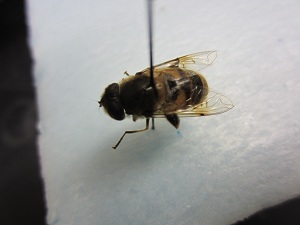
Syrphidae (Hoverfly); Suborder: Brachycera, Order: Diptera, Class: Insecta
            At Nose Hill, a hoverfly was found buzzing around the pond.  Syrphidae are common throughout the world, and are harmless to most other animals.  For their own protection, they closely mimic the more dangerous wasps and bees through Batesian Mimicry, serving to ward off predators.  Hoverfly mimicry include its physical warning colours of black and yellow, like many types of insects with stingers, a narrow waist like a wasp, and even the ability of mimicking the action of stinging.  Larvae hoverflies are found in stagnant water.  Like the caddis flies, different species of hoverflies eat different food.  Some are scavengers, eating decaying plants and animals, or on the outer of plants, or the bulbs, while others are predators and feed on other insects.  Adult hoverflies feed mainly on nectar and pollen, and honey dew produced by aphids.  Hoverflies are one of the few insects which can digest pollen.  With its mimicry of bees and wasps, hoverflies are prey for the opportunist birds and spiders.  Some wasps are also able to attack and kill aphid-eating larvae.
                                              Figure 8. Specimen of hoverfly in the family Syrphidae found at
                                                            Nose Hill by Ashley and Eugenia on September 29, 2011

Calliphoridae (Blowflies, Bluebottles, Greenbottles, or Cluster Flies); Suborder: Brachycera, Order: Diptera, Class: Insecta
            At Nose Hill, a blowfly was found in the environment surrounding the pond.  The name, blowfly, comes originally from the old English term for meat, which had eggs laid on it, which was said to be fly blown.  Adult blowflies are occasional pollinators, being attracted to flowers with strong, pungent smell of, or similar to rotting meat.  These flies use nectar as fuel for flight.  The larvae of this family of most species are scavengers for carrion and dung.

        Figure 9. Specimen of blowfly in the family Calliphoridae
             found at Nose Hill by Ashley and Eugenia on September 29, 2011


Coenagrion (damselfly); Family: Coenagrionidae, Suborder: Zygoptera, Order: Odonata, Class: Insecta
            At Nose Hill, damselfly larvae were found in the pond, specifically the Coenagrion larvae.  Damselflies are similar to dragonflies, but differentiate in that damselflies hold their wings along and parallel to their bodies when at rest.  The hind wings of damselflies are also fairly similar to its forewing, unlike the broadening of the dragonflies’ hind wings.  Larvae are predacious, and carnivorous, feeding on water fleas, mosquito larvae, and various other small aquatic organisms.  The adult Coenagrion eat flies, mosquitoes, and other small insects, including spiders, thus is a carnivore, and is predacious.  Damselfly adults can also be eaten by many organisms, such as spiders, and also suffer from parasites, such as mite larvae.

                                         Figure 10. Specimen of Coenagrion in the family Coenagrionidae
                                                        found at Nose Hill by Ashley and Eugenia on September 29, 2011


                           Figure 6. Vegetation found at Nose Hill by Ashley and Eugenia on September 29, 2011