Monday, November 28, 2011

Succession and Interaction of Nose Hill Park, by Masha and Celina

Changes are inevitable, despite whether they are pleasant or disastrous. We, as humans, cannot stop our growth regardless of how much we crave to stay away from the inescapable death. This is analogous to the planet earth, since it existed long before the first sign of life. Counting from present day, earth has been alive for 4.5678 billion years; even so, this is only one-third of the age of the universe. Hence, during this elongated period, changes developed in species of plants and animals, geographical contents changed, and separation of distinctive biomes have gradually occurred (and is still occurring) throughout the lifetime of earth. Scientifically, the world did not just appear from nowhere; there had to exist the first cell on earth. Through that first cell, the planet advanced to this collaborative world we are today – human sharing planet earth with citizens of nature. The image that readily jumps into our mind is Canada’s largest urban natural environment park – Nose Hill. Thus through this blog we will explore the different interactions between the organisms of the Nose Hill forest are, and the succession (the gradual colonization of a habitat after an environmental disturbance by a series of species) of the forest land over time.
Composition and structures will change drastically in response to the alteration of abiotic (nonliving) and biotic (living) conditions; these changes could include a rise in temperature or the introduction of a new species. An ecosystem is created from the abiotic and biotic factors, which are a community of living and nonliving things, and this is what Nose Hill Park is. The formation of the park was from a river flowing from the Rocky mountains to the west deposited gravels on top of sandstones and shale which are the hill’s bedrocks. Then, 15,000 years ago, ice sheets wore away rock and gravel, leaving Calgary situated in a glacial lake as a result of the last Ice Age. Five thousand years later, the Ice Age retreated leaving behind the foundation of Nose Hill. After the disturbance ended, which is any event that removes some individuals or biomass from a community (Freeman 2008), pioneer community began to take form and will eventually reach climax community. First, a simple description of a sere that developed in Nose Hill. It starts from rock to lichen, to moss, to grass, to shrubs, and lastly to trees. The seral stage or each phase of succession in an ecosystem is vital in leading itself to the climax community, which has stable biomass, efficient energy consumption with nutrient cycling, and high biodiversity of species. The forest area (2420 SW (510616011 N, 1140811211 W)) of Nose Hill is most likely the climax community, because of the numerous aspen trees present.
15 000 years ago, under the same glacier, there was also Edworthy park. As the glacier melted away, Edworthy turned into a temperate forest biome, while Nose Hill turned into a grassland biome. The glacier made a river that now flows through Edworthy Park. This river created more variation in species, in stabilizing temperature, and in slowing the rate of evaporating and sublimation of moisture and snow. On the other hand, because of Nose Hill’s geographic formation, which is the park’s South-facing slope, there is less sunlight that reaches and warms every part of the park. This limits biodiversity (the current rapid decline in the variety of life on Earth, largely due to the effects of human culture. (Campbell, N & Reece, J (2002), and can be proved by the sole existence of aspen tree. In comparison to Edworthy, varieties of trees such as the Douglas fir, pine trees, aspen, willow, and balsam polar can all be seen in great numbers. Hence Edworthy Park has more variety and numbers of coniferous trees than Nose Hill and these trees can serve as diverse habitat to varied species. This Nose Hill cannot.  
Edworthy Park has 408 producers in its area, out of which 325 are flowering plants, compared to Nose Hill’s 295 producers, out of which 222 are flowering plants. In the number of concentration of the flowering plants, Edworthy also has a higher percentage (75%) compared to Nose hill with a percentage of 80%. Edworthy Park also has more different habitats like river, pond and slough, grasslands, shrub communities, aspen woods, river line forests, and coniferous forests. In comparison, Nose Hill only has grasslands, shrub communities, aspen woods, and aquatic habitat types. We can notice some absences of other kinds of forests in Nose Hill, which might be caused by the elevation of the park, and where it’s located. In location comparisons, Edworthy Park is 1097 meters above sea level, and 76 meters from the Bow River. Nose Hill is 1125 meters in altitude. The upper part of Nose Hill has occasional drainage depressions. Edworthy Park is smaller than Nose Hill, because its 1.27 square kilometers in size, and Nose hill is 11.27 square kilometers. A major difference n Nose Hill and Edworthy Park is that Edworthy Park has the Bow River going through it. The river provides more habitat types for animals, and serves as a home to more species than Nose Hill can. In general, Edworthy Park has more types of species, a warmer temperature and higher levels of moisture than Nose Hill does. Now we will explore some insight into how Nose Hill revived after the last Ice Age.
Primary succession of Nose Hill is the recovery from the Ice Age, hence a disturbance that removes the soil along with the organisms that live in or above the soil. This succession is when bare rocks become habitats for lichens and algae, and the acids within them extract nutrients from the rock, causing them to form cracks. These tiny cracks are then widened by freezing and thawing over time to trap enough organic molecules and moisture for mosses to grow; this is known as the early successional community. These pioneering species are well adapted for growth in disturbed soils and devote most of their energy to reproduction rather than competition. As a result of their rapid growth, they tend to have a short life span, but a high reproductive rate. Afterwards, over a longer period of time, these cracks will have accumulated enough organic material to support the growth of grasses and small shrubs; this is called the mid-successional community. Subsequently these shrubs mature while the large cracks come together to form small basins so long-lived trees can invade the community leading towards late-successional stage. Lastly, as the trees mature, which in this case are the aspens, climax community will be reached. Therefore the primary succession process has been achieved.
Secondary succession follows the same process of primary succession except the organisms do not need to grow from rocks since the soil in the community is not removed by the disturbance. Hence the process is faster because there is no need for pioneer species, and the underground vegetative organs of plants may still survive in the soil. The fire that happened at Nose Hill on March 30, 2007 is a critical example of secondary succession. The fire consumed 40 hectares of land in Nose Hill, hence the organisms that live on that area of the land was observably killed; therefore the area will have to go through succession stages to recover again.
If you were only driving past Nose Hill and thinking that the land is merely a vast prairie with bald hills then you are definitely wrong. The 11 kilometers square land requires more than a passing glance to truly discover its beauty. The delicate blooming crocus, the soaring aspen towards the sky, or lovely deer with such innocence in their eyes might be easily overlooked if you have never dedicated the time to explore the inner essence of the park. Therefore, Nose Hill’s attraction to the unappreciative eye will seem subtle, but I sure do hope that you readers take the time to explore the nature of Nose Hill and seek the beauties within.
Now, we will discover the intriguing animals that live on this huge grassland biome-Nose Hill. Interactions are essential for animals to co-exist, this is the different ways that plants and animals interact with each other. The most common relations in-between organisms is the symbiotic relationship: any close and prolonged physical relationship between individuals of two different species. (Campbell, N & Reece, J (2002). One example of this type of relationship is known as mutualism. Mutualism is a symbiotic relationship between two organisms that benefit both. In Nose Hill, a mutualism relationship can be observed between bumblebees and flowering plants. During the summer, flowering plants want to reproduce, and when bumblebees land on them, they take some pollen to make honey for themselves, and as they fly away from the plant, they spread its seeds in other parts of the park. This represents a mutualism relationship because both the plant and the bumblebee benefit from this interaction.
Another symbiotic relationship is called parasitism. Parasitism is a relationship between two organisms that is beneficial to solely one organism - the parasite. This is the specie that benefits from this relationship, but the parasite causes detrimental harm to its host, which functions as the habitat for the parasite in which it spends a major proportion of its life in. However, this does not immediately kill the host, but will rather slowly damage the health of the organism. An example of this interaction is when deer ticks attach themselves to white-tailed deer that live in the forest ecosystem in Nose Hill. Those ticks get food, and a place to live in, and reproduce, so they benefit from this relationship hence they are the parasite (an organism that lives in or on a host species and that damages the host). Meanwhile, the deer suffer because they’re letting multiple different ticks (especially after reproduction) feed on its blood, and some ticks might carry disease, so the deer can get infected, hence the deer in this situation is the host organism.
Lastly, a symbiosis relationship, which literally means “at table together”, is identified as commensalism. This relationship is when the commensal benefits and the host neither benefits nor harms (Campbell, N & Reece, J (2002). This type of relationship can be seen when lichens grow on the higher branches of aspen trees in the forest ecosystem of Nose Hill. As lichens grow on trees, they receive their needed nutrients, and are able to grow, and reproduce. While this benefits the lichens, it doesn’t benefit nor harm the branch or the tree that the lichen is living on. The branch simply is a home for the lichens and provides the lichens with nutrients. In this case, the aspen tree is unmodified while the lichen is able to grow.
Through these examples of symbiotic relationships, we can summarize that animals in Nose Hill require interactions with each other, which is when both organisms of difference species live in close vicinity of each other for a prolonged time. Next, we will take a look at some of the competitions between species, which is also a type of interaction.
Intraspecific competition is the competition between members of the same species for the same limited resource (Campbell, N & Reece, J (2002). An example of this type of competition can be observed in Nose Hill is when the tallest tree and other shorter trees compete for sunlight. The height of the tree gains an advantage over absorbing the sunlight first and cast shadows over all shorter tress which makes less sunlight available for nearby trees. In the section we studied (10m by 1 m), the tallest tree was 7.3 meters high, while the others ranged from 2.1 meters to 6.5 meters. Thus makes this an exploitative competition type of interspecific completion. In this scenario, the 7.3 meters high tree will be able to absorb more sunlight than the shorter trees and will cast shadows over them.
Figure 1.0 Aspen Polar trees in the transect we
   studied at the forest area (2420 SW (510616011 N, 1140811211 W)
of Nose Hill on September 22, 2011.
A competition that’s similar to intraspecific competition is called interspecific competition. This type of competition between members of different species is for the same limited resources (Campbell and Reece, (2002). In Nose Hill, interspecific competition can be seen when spiders and wasps compete for the consumption of ground beetles. If the beetle is attacked or frightened by another species, it will release an obnoxious and irritating fluid from its abdomen. They can also use their powerful jaws to bite their attacker if provoked. This links us into the next type of interactions between organisms where animals imitate other animals to protect themselves as opposed to the beetles releasing stench fluids.
                Figure 2.0. Black ground beetle that was found in our transect of the forest area,
      located at (2420 SW (510616011 N, 1140811211 W)) of Nose Hill on September 22, 2011.
Mimicry is the most intriguing interactions in-between organisms. There are two different types of mimicriy:  Batesian mimicry and Mullerian mimicry. Mimicry is a phenomenon in which one species has evolved to look and sound like another species. First, Batesian mimicry is a form of mimicry in which a harmless species resembles a dangerous or poisonous species. In Nose Hill, this type of mimicry can be seen when spiders imitate ants. The spiders use the disguise of ants to escape their predators, which is any organism that kills another organism for food (Campbell and Reece, 2002).  In this case the birds and wasps are the predators of spiders. Second, Mullerian mimicry is a natural phenomenon when two or more harmful species, that may or may not be closely related, resemble each other (Campbell and Reece, 2002). This type of mimicry can be seen when various bees have the aposematic yellow and black stripes. Females of most of these species are potentially harmful to predators, fulfilling the second requirement of Mullerian mimicry. However, in essentially all such species, the males are harmless, and can thus be considered automimics of their harmful females. The males will win, and their predators will loose, because they will confuse the female and male wasps with each other. Protective coloration is another way that mimicry can be described. This is when species camouflage, or make themselves blend in with the environment that they live in by their colour, so that their predators doesn’t see them.
Figure 3.0 This specie is a daddy long-leg that was found in the transect we studied in the forest area of Nose Hill (2420 SW (510616011 N, 1140811211 W).
The picture is taken by a picture motion microscope provided by Sir Winston Churchill High School under the 400X view. As many people might consider them as spiders, because they have eight legs, and they look like them, but actually, they’re not spiders, nor insects. It’s a pholcidae, or cellar spiders. Their oval body, which connects all of its eight legs, acts as the abdomen. This part is about 0.5 centimeters, and their legs are about 3 centimeters. Their second legs as people might think are legs, but actually are antennae. They’re most active in the summertime, but can be seen in the fall, and colder months of the year. They’re native to North America, as the fossil records, and are about 300 million years old, as scientists age the fossils. They’re omnivores (an animal whose diet regularly includes both meat and plants. Freeman (2003), and eat anything form insects to fecal material. This is another trait that’s different from the spiders’. The daddy long-legs usually live about a year and will die because of the cold weather. They reproduce sexually, and females lay eggs from days to months. The eggs are laid and hatch in the ground somewhere during early spring until mid-summer. The males often protect the eggs from the egg-eating females. If it’s attacked, it can play dead, or release on or two of its legs, which twitch due to a “pacemaker”. Their color can be either dark brown or grey which makes it a camouflage color (a colour that blends in with their habitat or environment). These creatures also have fangs for predation, but it doesn’t contain venom glands, and therefore, they aren’t poisonous. This allows the daddy long-legs to escape if the predator is distracted.

References:
Pinel, H. (1980). Calgary’s Natural Areas, Calgary:
The Calgary Field Naturalists Society
Freeman, S (2003) Third Edition Biological Science. San Francisco:
Pearson Education
Campbell, N & Reece, J (2002) Biology Sixth Edition. San Francisco:
Pearson Education
Walker, L.R & Moral R. (2003). Primary Succession and Ecosystem Rehabilitation
            Cambridge University Press

The Interactions Found in Nosehill Natural Environment Park by Ashley and Eugenia

            Through our trip to the pond in the south of Nosehill Natural Environment Park on September 29th, 2011, we were able to collect and preserve many different species of visible living organisms.  Through research, and help from Dr. T. Pike, the Biology 20 IB teacher at Sir Winston Churchill High School, in species identification, the interactions between the species were established.  A simple explanation of each species interactions in the environment at the pond is given below, with pictures of the preserved species.

                                         Figure 1. Pond at Nose Hill taken by Ashley and Eugenia on September 29, 2011

Hirudinea (Leeches); Order: Pharyngobdellida, Family: Erpobdellidae
At Nose Hill, a type of leech in the family Erpobdellidae was found in the pond.  Leeches are non-anthropods and are found in freshwater.  Leeches of the order Pharyngobdellida are primarily fluid feeders and are found in standing and running water.  They are predacious, but they do not have jaws.  This allows the leeches to swallow a whole variety of small invertebrates or suck the fluid out of large prey.
These leeches are involved with other organisms through interactions such as predation.  Predation is defined as the killing and eating of an organism which is the prey, by another organism which is the predator.  In one interaction, leeches are the predator and prey on small or large invertebrates.  The leech gains food and energy from the prey which are the invertebrates while the invertebrates are killed.  In another interaction, leeches are the prey and the predators that prey on them are walleyes, which is a type of fish.  The walleye gains food and energy from the prey which is the leech while the leech is killed.  Through these interactions, leeches are shown to have a feeding strategy of a tertiary or higher consumer.    
                                               Figure 2. Specimen of Hirudinea in the family Erpobdellidae found at
                                                         Nose Hill by Ashley and Eugenia on September 29, 2011
                             
                                           Figure 3. Specimen of Hyalella azteca found at Nose Hill
                                                          by Ashley and Eugenia on September 29, 2011

Gastropoda (Snails); Subclass: Pulmonata, Family: Lymnaeidae
            A type of Stagnicola gastropod was found in the pond at Nose Hill.  Gastropods are abundant in most aquatic habitats of Alberta.  The shell of gastropods is always present and it is well developed in freshwater specimens.  Freshwater gastropods are generally herbivorous and they weed on algae growing in ponds, lakes and streams.  Based on their feeding habits, gastropods are a primary consumer. 
             These gastropods are involved with other organisms through interactions such as predation and parasitism.  In one interaction, gastropods are the prey and the predator is a carnivorous insect such as fireflies.  The firefly gains food and energy from the prey which are the gastropods while the gastropods are killed.  Another interaction that gastropods are involved is parasitism.  Parasitism is defined as a long term physical relationship between two organisms where one organism benefits and the other organism is harmed.  Freshwater snails are the hosts for parasites such as the larvae of blood flukes.  The larvae of the blood flukes gain nutrients from living in gastropods such as Lymnaeidae, and the gastropods slowly die because their nutrients have been robbed by the blood flukes.

                                                 Figure 4. Specimen of Gastropoda in the family Lymnaiedae found
                                                      at Nose Hill by Ashley and Eugenia on September 29, 2011

Anisoptera (Dragonflies); Order: Odonata
            At Nose Hill, dragonflies were found around the pond.  The dragonfly is an anthropod.  It is in the class of Insecta under anthropods where less than 5% of insect species have an aquatic stage.  There are over 90 families of aquatic insect in 11 orders present in Alberta.  The dragonfly is under the order Odonata which also has two additional suborders including Zygoptera and Anisozygoptera.  Four families of Anisoptera are found in Alberta which represents approximately 50 species.  The larvae of the four dragonfly families are widely distributed throughout the province.  Dragonflies are predacious in larvae and adult stage.  In larvae stage, aquatic invertebrates are captured with the large labium.  In adult stage, the dragonflies feed on other flying insects.  From this feeding strategy, dragonflies are identified to be tertiary or higher consumers. 
            Dragonflies are involved with other organisms through interactions such as predation.  In this interaction, dragonflies are the predators and prey on insects and aquatic invertebrates.  The dragonfly gains food and energy from the preys which are the aquatic invertebrate and insect while the aquatic invertebrate and insect are killed.  
                                                       Figure 5. Specimen of Anisoptera found at Nose Hill by
                                                                Ashley and Eugenia on September 29, 2011
Vegetation
Around the pond at Nose Hill, numerous species of vegetation were found.  The plants are the primary producers which the primary consumers consume.  

Caddis Fly; Order: Trichoptera, Suborder: Amphiesmenoptera, Class: Insecta
            At Nose Hill, a caddis fly casing was found in the pond, motioning to the presence of Trichoptera larvae.  Caddis fly larvae are adapted to many types of aquatic environments, and live in casings made from rocks, sand, gravel, twigs, leaves, and other debris.  Trichoptera larvae uses substance secreted from silk glands in the lower lip to glue materials together.  With these glands, Trichoptera larvae are able to use the glue like substance to spin and create nets, straining material from the water for food.  Caddis fly larvae feed differently from the adults.  Adult Trichoptera feed only on liquid food, such as nectar or sap, in result of a vestigial mouth.  Caddis fly larvae feed on a mixed diet.  Varying species of caddis flies feed on differing organisms.  Some species are predacious, while others are leaf shredders, algae grazers, and collectors of particles.  The can eat algae, leaves, fungi, detritus, water flea and other invertebrates.  Trichoptera are also prey for many organisms, such as dragonflies, dobsonflies, and large diving beetles.
                                                    Figure 7. Specimen of caddis fly in the family Trichoptera found
                                                          at Nose Hill by Ashley and Eugenia on September 29, 2011
Syrphidae (Hoverfly); Suborder: Brachycera, Order: Diptera, Class: Insecta
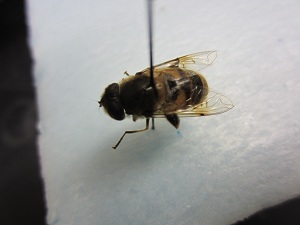
            At Nose Hill, a hoverfly was found buzzing around the pond.  Syrphidae are common throughout the world, and are harmless to most other animals.  For their own protection, they closely mimic the more dangerous wasps and bees through Batesian Mimicry, serving to ward off predators.  Hoverfly mimicry include its physical warning colours of black and yellow, like many types of insects with stingers, a narrow waist like a wasp, and even the ability of mimicking the action of stinging.  Larvae hoverflies are found in stagnant water.  Like the caddis flies, different species of hoverflies eat different food.  Some are scavengers, eating decaying plants and animals, or on the outer of plants, or the bulbs, while others are predators and feed on other insects.  Adult hoverflies feed mainly on nectar and pollen, and honey dew produced by aphids.  Hoverflies are one of the few insects which can digest pollen.  With its mimicry of bees and wasps, hoverflies are prey for the opportunist birds and spiders.  Some wasps are also able to attack and kill aphid-eating larvae.
                                              Figure 8. Specimen of hoverfly in the family Syrphidae found at
                                                            Nose Hill by Ashley and Eugenia on September 29, 2011

Calliphoridae (Blowflies, Bluebottles, Greenbottles, or Cluster Flies); Suborder: Brachycera, Order: Diptera, Class: Insecta
            At Nose Hill, a blowfly was found in the environment surrounding the pond.  The name, blowfly, comes originally from the old English term for meat, which had eggs laid on it, which was said to be fly blown.  Adult blowflies are occasional pollinators, being attracted to flowers with strong, pungent smell of, or similar to rotting meat.  These flies use nectar as fuel for flight.  The larvae of this family of most species are scavengers for carrion and dung.

        Figure 9. Specimen of blowfly in the family Calliphoridae
             found at Nose Hill by Ashley and Eugenia on September 29, 2011


Coenagrion (damselfly); Family: Coenagrionidae, Suborder: Zygoptera, Order: Odonata, Class: Insecta
            At Nose Hill, damselfly larvae were found in the pond, specifically the Coenagrion larvae.  Damselflies are similar to dragonflies, but differentiate in that damselflies hold their wings along and parallel to their bodies when at rest.  The hind wings of damselflies are also fairly similar to its forewing, unlike the broadening of the dragonflies’ hind wings.  Larvae are predacious, and carnivorous, feeding on water fleas, mosquito larvae, and various other small aquatic organisms.  The adult Coenagrion eat flies, mosquitoes, and other small insects, including spiders, thus is a carnivore, and is predacious.  Damselfly adults can also be eaten by many organisms, such as spiders, and also suffer from parasites, such as mite larvae.

                                         Figure 10. Specimen of Coenagrion in the family Coenagrionidae
                                                        found at Nose Hill by Ashley and Eugenia on September 29, 2011


                           Figure 6. Vegetation found at Nose Hill by Ashley and Eugenia on September 29, 2011

Meanwhile, back at the pond... by Ashley and Tanica

                Nose Hill Park is one of the biggest municipal parks in all of North America. Even though the majority of the land in Nose Hill Park is grassland, there are other different ecosystems in the park such as the forest and pond. The pond ecosystem and the major effects of plant species on the animal species in the pond and the factors affecting the plant species will be discussed in this entry.

            Figure 1. Photo of the pond at Nose Hill Park. Note the No Dogs sign which is a significant affect to the duck population there. Photo taken by Ashley.

Plants are very important to the ecosystem of the pond. They are the source of almost all of the animals living in the pond and they control the healthiness of the pond itself. Because of the different plant species, there are many different animal species that live in the pond. From this direct correlation, all ponds are unique depending on the plant species that they contain. The pond being studied is the Nosehill pond located at approximately 51.1°N and -114.1°W. It is a manmade storm water pond, but still contains several different species of both plants and animals. Because of the plant species growing in the pond, the animal species have also adapted to fit the plant species.
                There are many plant species in and around the pond. Some of the species of plants include Mentha arvensis (Wild Mint), Schoenoplectus acutus var. Acutus (Hardstemmed Bulrush), Elodea Canadensis (Pondweed), Potamoeton pusillus (small pond weed), Typha latifolia (Cattails), algae, and phytoplankton. The wild mint actually acts as a repellent for all the animals that we deem as pests which slightly lowers the pest population where there are bundles of wild mint.

 
             Figure 2. Photo of wild mint (Mentha arvensis) collected by Mrs.Miller. Picture was taken by Ashley.

Aphids and other small insects feed on the Hardstemmed Bulrush. Because of the abundance of this plant, this will increase the aphid population and also bring in other animals or insects that feed on aphids and small insects closer to the pond as well.


            Figure 3. Picture of the abundance of the Hardstemmed Bulrush (Schoenoplectus acutus var .acutus) that grows near and in the pond. Photo taken by Ashley.

The pond weed is food for many fresh water organisms as well as birds. This results in the increase of ducks and other birds in the pond which also eat many other organisms living in the pond. The cattail is also a source of food for many animals such as deer and ducks and provides habitats to a large number of the bird population.


            Figure 4. The cattails (Typha latifolia) found at the pond at Nose Hill Park. Picture taken by Ashley.

Algae can range from unicellular organisms to multicellular organisms, but are limited to eukaryotes. Alga found in the pond is a food source for many smaller animals such as Gammarus lacustris (Fresh water shrimp). Phytoplankton are also found in the pond and serve as a base for many pond ecosystems. They are autotrophs that contain chlorophyll but they are unable to be seen without some sort of magnifying device. They are the food source of many organisms, including Gammarus lacustris (Fresh water shrimp). The plants are responsible for pulling together the ecosystem and all of the different animals that are found in each specific ecosystem.
                The temperature based on the latitude of the pond ecosystem changes the plants that are present in the pond. The temperature of the air at Nose Hill Park at the time that it was studied was 20.0°C and the temperature of the pond at 20 cm ± 5 cm at the centre was 14.9°C. The location of the pond is approximately 51.1°N and -114.1°W. This affects the plant species because all those plants that are unable to live within the ranges of temperature will die quickly and create room for those that are able to grow in the temperature ranges to survive and prosper. Thus, one of the main abiotic factors affecting the ecosystem of the pond is temperature.
                Abiotic factors also affect the pond’s plant species. Because of the way this pond was created, almost everything left out during rainy weather can possibly end up in this pond. Through this method, high volumes of dissolved pollution can flow into the pond through run-off and leaching. If certain species of plants are very sensitive to pollution, and there is too much pollution, many of the sensitive plant species can perish, which leads to the death of several other animals that are vital to the pond’s ecosystem. This ends up tipping the balance of the ecosystem and can seriously harm it.
                Through these different plant species, different animal species are able to live in this ecosystem. There are several animals that were found in the pond such as Odonata corduliidae (Green eyed Skimmer), Gammarus lacustris (Fresh water shrimp), Phalangium opilio (Daddy Long Legs), Ephemerella aurivillii (mayfly larva), and ducks. Several of these animals feed on the plants found in or around the pond (as primary consumers) or on other animals that eat the plants in or around the pond (as secondary consumers). In order for the animals to survive better, they will all live in or close to the pond to get their food sources. If there were no plants in this that the primary consumers could eat, then they would all die of starvation and the secondary consumers would also die because of the same reason. Another situation is that if there was another species of plants introduced (most likely invasive to a certain extent), then there was an animal better adapted to consume the plant would survive much better than the previous animals that were originally living in that habitat. Through this, plant species are very important to the structure of the ecosystem.


            Figure 5. Fresh water shrimp (Gammarus lacustris) found in the pond. It is a decomposer but also eats algae found in the pond. Photo taken by Ashley.


            Figure 6. Phalangium opilio (Daddy Long Legs) found around the pond. It is a secondary consumer and feeds off of small insects. Photo taken by Ashley Choo.


               Figure 7. Duck found swimming in the pond during arrival at pond. Ducks are primary, secondary, and tertiary consumers depending on which needs it needs to meet and consumes the plants living in and around the pond as well as some of the insects and animals that live in the pond. Photo taken by Tanica.

                Because of the different plant species, there are different animal species in the pond ecosystem at Nose Hill Park. The plant species is the main reason that all of the animals that were found in or around the park. The plants found in the pond are specific to the animals found in the pond, as the primary consumers are adapted to specifically consume them and then the secondary consumers prey upon the primary consumers.

A Parasitism, Predation, and Other Forms of Interactions in a Peaceful Pond

By Paul and Alexis

Nosehill. A simple park, or a complex ecosystem? Careful study of the intricate ecosystem present at Nosehill reveals an elaborate and sophisticated environment where a plethora of organisms dwell, feeding trophic levels throughout Calgary. This seemingly simple park contains some of the largest mammals found in Calgary, along with a multitude of birds and bugs. Study of the ecosystem and structures show that a multitude of interactions between species transfer energy and establish an advance community. However, exactly which species can be found at Nosehill? Many citizens in Calgary are unaware of any organisms smaller than their hand, yet dozens upon dozens of organisms dwell at Nosehill. From the multitude of organisms it is only natural that a complex but sturdy web of interactions is formed.
One of the most interesting areas at Nosehill is the pond located near the the John Laurie Blvd and Shaganappi Trail entrance. The multitude of microscopic organisms found lead way to a community where organisms smaller than a finger thrive. Organisms such as the water boatman and water strider can be found just on the surface on this intricate aquatic ecosystem. Leeches and diving beetles can be found under the surface living off plants and sometimes other organisms that they encounter. These organisms interact in mingle in unique ways, ranging from mutualism to predation to mimicry. Through this blog we will discuss the various relationships that have been established between organisms along with succession that would occur at Nosehill.
One of the most integral interactions that can be found at Nosehill is that of the predation reaction, where an organism consumes prey for energy. This interaction builds the stable ecological community we experience when we go for a serene walk through Nosehill, feeding organisms such as the  ducks, spiders and many members of the dytiscidae species. Although these predation interactions are often changing, they build upon careful symbiotic relationships between organisms. One such example of symbiosis is parasitism. Parasitism is the relation between organism in which one organism benefits (the parastite) while the other organism is harmed (the host). At the Nosehill pond, a parasitic relationship would be between organisms and the leeches we find at the pond. The parasite - being the hungry leech - is able to feed on the human therefore gaining a food source, ducks and cat tails are the hosts they attach on to, and therefore are harmed because consumption and transferred diseases would instigate the decline of the population. Thus, the population of the leeches would increase. This process is cyclic, the population of leeches will plateau and decline once the population of cattails is not great enough to maintain the consumption of leeches. As the leech population declines, the cattail population will increase due to less predation, and so on.
However the interactions we find at Nosehill are not always damaging to one of the participants. We find examples of mutualism and types of mimicry (Batesian mimicry) that allows both organisms or species involved to benefit. A unique example of this would be the mullerian mimicry of bees and hornets found there. Since both these organisms are harmful predators will start to avoid them, and due to the shared coloring of their bodies will avoid the other organisms as well. This benefits both species, and is considered mutualism, because once a predator encounters one of the similar looking dangerous species, it will learn to avoid anything with similar qualities. This also benefits the predator, because it isn’t putting itself at risk by attacking other dangerous organisms. Both organisms  Another example of this mimicry found at Nosehill is that between a robber fly and a bee.  The robber fly imitates the patterns found on the bee, causing predators who see it to avoid eating it due to likely previous experiences in being stung. In this case, the robber fly is able to benefit off the fear caused by the model bees without really harming the bees. This type of mimicry is that of Batesian mimicry, where a non-threatening organism (the mimic) copies the behaviours and physical qualities of that of a threatening or dangerous organism (the model). Batesian mimicry is therefore a type of commensalism, where one organism benefits, and the other organism is not affected (in that it is neither harmed nor does is benefit). This is because the mimic benefits - predators will generally try to avoid them since they resemble dangerous organisms, therefore the likelihood of survival increases. The model neither benefits, nor is harmed.
Interspecific and intraspecific competition were also discovered throughout the pond ecosystem at Nosehill, mainly between the plethora of plant species and organisms found. Although sunlight does not seem like a scarce resource for us, for many plants only the highest one may get the most sunlight. This leads to competition within species, such as the number of grasses and cat tails discovered, as well as competition between species, such as algae, seaweed often cat tails.       
The plants that obtain the most sunlight will be able to survive the best, grow the most and be most likely to reproduce. This leads to the ecological community we see at the Nosehill pond. However, this community hasn’t been as it is today for very long: a wide range of events and processes formed and established the community we see today. An early community we would see would be that of mainly grasses in a pioneer community. This succession would sprout mainly from the dirt already present due to the fact that Nose Hill was prairie land previously, causing this process to be secondary succession. The only primary succession likely to occur would be that from any completely destroyed ecosystems - caused mainly be roads - that have been replaced by any expansion in the area of Nosehill that may have occured. This series of succession-based changes - known as a sere - in a community would eventually lead to an ideal climax community in which further stages of succession would most likely not continue to occur. Since this community is most likely the final stage in succession, it is probable that the pond ecosystem at Nosehill hasn’t reached a climax community. If the pond ecosystem did reach a climax community however, a large amount of aquatic fishes and larger aquatic organisms would most likely exist. Unfortunately the only organisms discovered at the pond that were larger than a hand were ducks - showing that the Nosehill pond is most likely at a middle stage in succession.
However with that said, there seems to be an optimistic future for the Nosehill pond ecology. Events such as the addition of dog prevention signs around the pond - increasing the population of ducks found substantially - allow optimum development in succession stages, hopefully leading one day to an ideal climax community. This in combination with the stable interactions and habits - such as mimicry, commensialism and protective coloration - carefully established in the ecosystem will lead way to more organisms, hopefully leading way to a plethora of organisms being able to strive. However the pond ecosystem isn’t the only seemingly successful microecosystem so far. Stable forest and grassland habitats were discovered across Nosehill, showing promise for a bright future for not only this ecosystem, but for the environment of Calgary as a whole.

 
Figure 1. An image of the pond in the corner of Nosehill Park, beside the entrance on John Laurie Blvd. and Shaganappi Trail.


Figure 2 Leeches discovered on the leaves of cattails in the water on the shore of the pond


Figure 3. A duck found in the Nosehill pond, there aren't many large organisms like ducks, meaning that the Nosehill pond may not have reached a climax community yet.


Figure 4. Dr. Ted Pike standing beside the "No Dog" sign at Nosehill Pond


Wednesday, December 15, 2010

Nose Hill Park pond; fall 2010, by Mariah and Brittany

Figure 1: Photo of Nose Hill pond.
Taken by Brittany M. on 09/2010
The human body is made up of approximately 50-65% water. Our brains are about 85%, and our bones are around 15%. Now imagine if all of that water in our body was polluted with gasoline, storm run-off, sewage and fertilizer. If this were true, it would make it near impossible to live healthy, happy lives. If we are unable to live in these predicaments, why should other organisms have to either?

Figure 2: Photo of Mariah L-R at
Nose Hill pond. Photo taken by
Brittany M. on 09/2010
 Nose Hill Park pond is a man made pond. It is the water source for many living, breathing, important organisms that allow the food web to cycle. Without the proper living conditions, these animals aren’t known to survive in Nose Hill Park for long. Animals such as deer, coyotes, and even porcupine reside in Nose Hill Park. These animals require water to live, therefore, taking advantage of the nearest water source…the pond.
Figure 3: Tiny flower found floating on the
surface of the water in Nose Hill pond.
Photo taken by Brittany M. on 09/2010.
My lab partner and I took a couple trips down to Nose Hill Park pond to research the organisms living in and around the pond, we did this to see if we could grasp a better understanding of the quality of the water and some things that could be the cause of the pollution or lack there of. We observed that there were many different species of insects living in and around Nose Hill Park pond. Some of these include; Cactus Fly Larvae, Water Boatman, Leeches, Amphipod, Damsel Fly Larvae, and May Flies. After further research, we concluded that these are all clean water indicators telling us it isn’t too late to change what will most likely be the outcome of this pond…death by pollution. While collecting specimens and samples from the pond, my partner and I observed a small patch of mud with what looked to be some sort of oil or gasoline, and after testing, we realized that it was in fact oil. The oil could have gotten onto the outskirts of the pond in a variety of ways, but what we all know for sure is that it is because of human interaction.
In order for change to occur, we must be aware of the problems within the pond. High levels of Phosphate (PO43-) contribute to high algae growth and often results from over feeding or infrequent water changes. After further research, we established that the level of phosphate in a fresh water pond should be approximately 0mg/L; however, the phosphate levels from Nose Hill Park pond were noticeably higher at 2.5mg/L. High levels of nitrate in a fresh water pond indicate high levels of pollution. Nitrate levels in freshwater should be around 10mg/L in order to be safely consumed. Our test results showed that the pond in Nose Hill Park had nitrate levels at around 5 mg/L telling us that the water does in fact meet the federal health standards for fresh water. Concluding our experiments, we have established that the water is in fact clean, but at the same time, high amounts of algae are present which affects the amount of oxygen the other organisms in the pond can consume.
As one of the largest municipal parks in Canada, Nose Hill Park is often visited by our rapidly growing population and their pets. Although the pond may be satisfactory at the moment, it will not stay that way for long because of human interference and animal waste. It is up to us to change our harmful behaviours now before the pond is terminated. If Calgarians continue on the path that we are on leading to the destruction of the Nose Hill Park pond, it will not only affect the organisms living there now, it will also affect us. From the first stage of pollution running off into the pond from residential areas near by, the water in the pond is contaminated which is later consumed by producers in and around the pond through root uptake. Primary consumers such as deer and rabbits, innocently feed upon the contaminated producers and are thus affected by the polluted water as a result of human negligence. Next victim to the human ignorance are the secondary consumers such as coyotes. The secondary consumers feed off of the tainted primary consumers and therefore ingest the pollution. As the chemicals and human substances move up the food chain, the concentration of the pollution amplifies, this process is known as bioamplification.
As the population in Calgary grows, the amount of pollution in and around us grows along with it. Calgarians need to recognize the dramatic negative affects their lack of attention causes to the beautiful habitats that surround us; such as the Nose Hill Park pond, and change their actions immediately…before its too late. We should take note on how the level of contamination in and around the pond varies as time goes on and make sure we are taking drastic action to keep Nose Hill Park as pleasant of a park as it can be, starting with the pond.